New Zero Waste Group in Sicily

On August 31st it was constituted a new Zero Waste local group in Sicily.

The Zero Waste Association in Sicily declared its commitment to work for a responsible waste management system in Sicily aiming at increasing waste reduction, reuse and recycling and continuosly reduce the amount of waste send for either landfill or incineration.

The majority of municipal solid waste in Sicily being biowaste the organisation Zero Waste Sicily will focus on promoting separate collection of biowaste, composting and anaerobic digestion of this waste fraction.

For more info: http://www.rifiutizerosicilia.it/

Phasing out single-use plastic-bags

Plastic bags, especially the single-use ones, are slowly leaving us. The good news is that this is happening, the bad news is that the process is too slow and they continue to harm our economies, health and environment.


Since their introduction in the US in 1957 they have expanded all over the world and now they can be found everywhere; oceans, rivers, mountains, fields, cities, homes… everywhere. The reason for their success was that they were cheap, light, higienic, resistant and the reason why they should be phased out is because it is not true that they are that cheap; it is just that their producers were not bearing the costs, people are. The costs of cleaning the cities, seas and fields, the costs of floods that plastic bags cause when they block the draining systems, the costs of fixing the machines blocked by plastic bags in the waste separation plants, the costs of loss of biodiversity because of death of animals by suffocation or contamination, the health costs of having more and more plastic in the food chain, the costs of tourism not wanting to come back to a country where there are more plastic bags than birds in the air… all these and many more are costs that the society is bearing and this is why the end of plastic bags is near. It doesn’t make neither economic nor environmental sense.

From the point of view of industrial design the pastic bags are a complete disaster; they are a product with a potentially high impact but whose life is very short and what’s worst is that they are absolutelly dispensable. We lived without plastic bags until some years ago and we will continue to live without plastic bags in the future.

The regulation on plastic bags around the world is increasing: in places such as China or South Africa there are outright bans on the thinnest, least durable plastic bags, in other places such as Taiwan they opted for taxes.

So, what are the experiences in Europe to reduce the consumption of plastic bags?

Ireland

The most succesful example in Europe is Ireland which introduced a “PlasTax” in 2002 –law 605/2001 – of 0,15€ per bag and managed in only 6 months to reduce the use of single-use plastic bags in a 90% and which created a revenue for the state of 19 million euros. The tax is applied in shops, supermarkets and other public places and excludes the reusable bags sold for more than 0,70€, the small bags containing bulk meat, fish, ice, fruits and vegetables and the bags in planes and ships. Infringement of the norm is sanctioned with fines starting from 1905€. The BBC reported that in three months after the ban was introduced, shops handed out 277 million plastic bags fewer than normal.

France


On the last January 1st entered into force a ban on the selling of non-biodegradable plastic-bags, the fine for violating the law is of 100€. According to a survey from WWF in 2005, 83% of the french were in favour of banning single-use plastic bags in supermarkets.

Denmark

As part of a larger packaging tax introduced in 1994, Denmark taxes plastic bags. The stated aim is to promote the use of reusable bags. However, the tax is paid by retailers when they purchase bags, rather than by shoppers, yielding less dramatic results than the Irish PlasTax, which charges consumers directly for each bag used. Still, consumption of paper and plastic bags has declined by 66%.

Spain

The region of Andalucia has  recently approved the first-ever in Spain tax (5 eurocents) on single-use plastic bags to be introduced in 2011. With a population of 8.3 million people Andalucia could raise 100 million euros next year, and twice as much when the tak will be doubled in 2012. Other autonomous regions in Spain such as Catalonia have targets to reduce single-use plastic bags but no measures -tax or ban- as to how to make it happen.


In other countries such as Germany, Belgium, Italy, Netherlands or Hungary the big supermarkets charge for the plastic bags.
Several initiatives and campaigns are taking place in different parts of Europe in order to push the authorities to act against plastic bags. There is no concrete EU policy regarding plastic bags.

On the 3rd of July 2010 took place the first International Bag Free Day, coordinated by Fundació Catalana de Prevenció de Residus i Consum and GAIA.

If you happen to know other campaigns or policies against plastic bags in Europe please let us know.

Phasing out plastic bags in Europe and replacing them with reusable bags is part of a Zero Waste Strategy in Europe; it reduces waste, it reduces costs, it promotes sustainability and is good for the environment and our landscapes.
To conclude we leave you with the video of the life of a plastic bag that is used to push the ban on plastic bags in California:

Zero Waste practices to reduce waste in the milk and dairy market in Europe

“One litter of milk is produced somewhere, then it has to travel to be packed in often unsustainable packaging hundreds of km away then it needs to travel again to a supermarket so that the consumer can buy it. After short period of use the packaging ends up in the waste bin. Milk without taste, expensive for the consumer, impoverishes the producers and it harms the environment.” This is unsustainable.

What about “One litter of milk is produced in a farm which is some km away from the milk-machine from which the consumer can refill a reusable recipient, enjoy the better tasting product and pay less money whilst the milk producer makes more profit and the environment suffers from less CO2 emissions and waste. A win-win situation for the producer, the consumer, the market and the environment.” Now, this is sustainable.

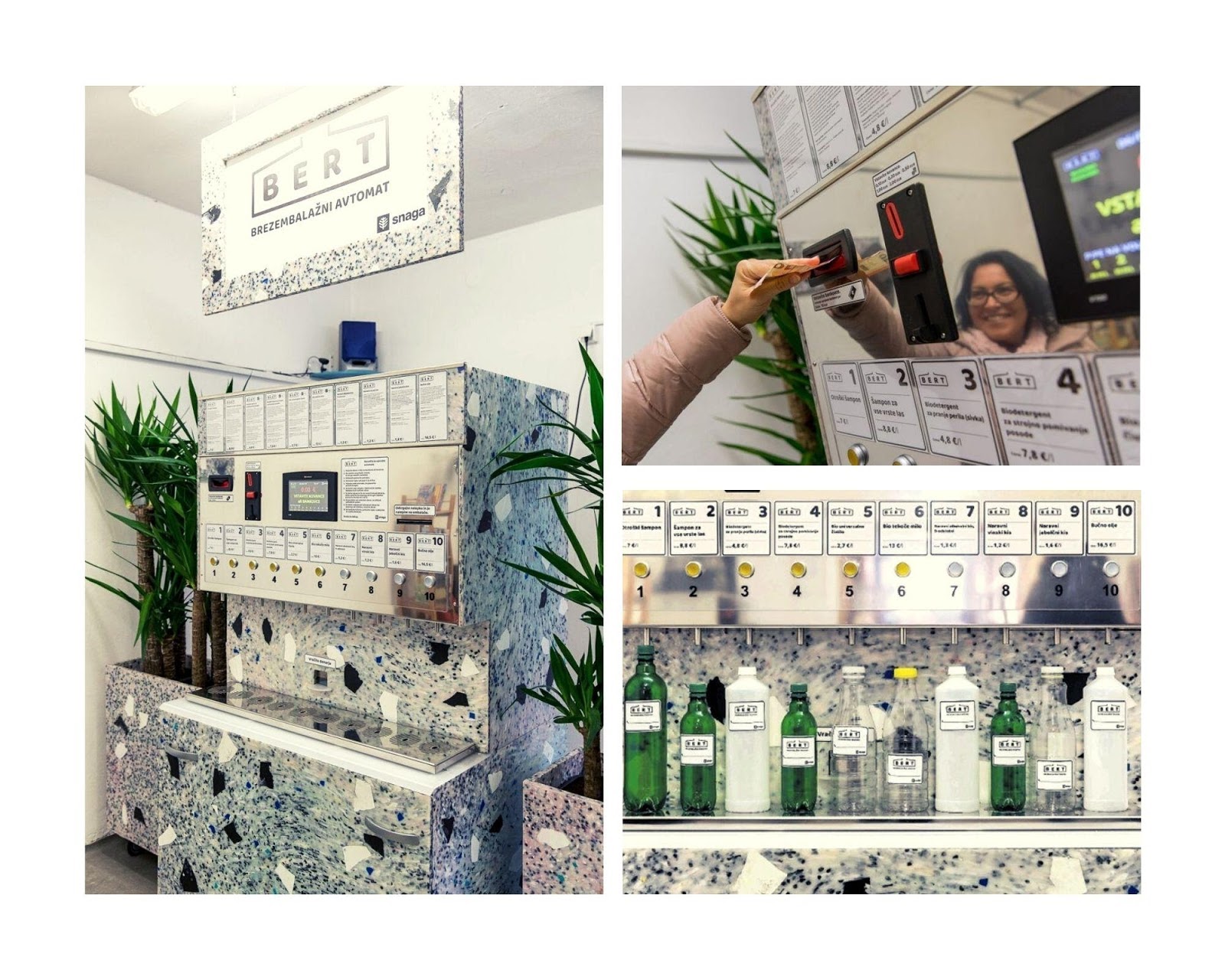
Since some years all around Europe the milk producers got organised to deliver the milk directly to the consumer in a move that is good for the consumers, is good for the producers and it goes in the direction of Zer Waste. Some examples:

In Italy
The Italian Zero Waste Communities have been in the forefront of the implementation of the milk automat machines, now the system is spreading everywhere in Italy, mainly fostered by:
• the price issue – (remarkably) lower price for consumers, higher income for farmers,
• much less waste, hence less economic and environmental costs –for the households, for the municipalities and for the producers,
• more healthy milk for everybody – and more tasty too (not being neither skimmed nor homogenised the milk fat is remarkably more tasty,
• the so called “zero km” campaign, launched by farmers’ associations and the “slow-food” movement in order to support local production/consumption of food and typical local productions (quite a few restaurants are now offering “zero km” lists, and this is becoming a “trendy” feature of restaurants)

The technology used in Italy can be found here.
The success in waste reduction has pushed the ZW municipalities to install “Water Houses” –for both still and sparkling water- next to the milk machines where the citizens can get water for free without generating the waste that the bottled water produces.

In France:
Distrilait is the homologated distributor of milk and so far 85 milk distributors have been installed in France.
It is possible to bring your own bottle or recipient and fill as much as you want and if you forget your bottle, the automat has an integrated dispenser bottles.
You can see a video –in French- here.
Every milk machine costs 50,000 euros and the milk is sold 1 € per litter, that is 2 or 3 times more than the price given to the farmers by the big supermarkets.

In Slovakia

The system of milk automats was implemented in 2009 as a result of the crisis that hit the milk producers because of the extremely low prices they were paid for their product. These pushed some milk producers to opt for direct selling to consumers. In the beginning the machines were subsidised but the success was such that now there are more than 100 machines in operation and they don’t need subsidies anymore. To see a map of the milk machines in Slovakia click here.

In the Czech Republic
In the Czech Republic there is  similar success to the one in Slovakia which caused that the producers of the packaging of the industrial milk Tetrapack –which is very hardly recyclable and goes against waste prevention- launched accusations against the milk from these automat machines. Luckily the machines continue to operate.

In Spain


There are machines working in the Basque Country, Navarra, Asturias, Sevilla, Madrid and Catalonia. For instance, in Catalonia there are hundreds of machines distributing fresh milk coordinated by LletFresca.com.


Other Spanish regions such as Castilla y León have encountered more problems but they are moving ahead.

Many other countries such as Slovenia, The Netherlands or Switzerland have implemented the idea with huge success.

Here we have another example of how a Zero Waste practice can be good for the environment and at the same time be also good for the consumers and producers and hence for the sustainability of our economies.

SOS message to Copenhagen – Save Our Soils

The final resolution reads:
1. In support of our children’s children, we recognise that this generation has the responsibility to repair the damage caused by the human induced aspects of global warming.
2. The simplest, quickest and most cost-effective way to address global warming is to encourage every human being in the world to source separate the organic fraction from their discard streams, so that it can be composted and returned to agriculture. In this way the carbon can be  captured in the soils of the earth.
3. We call upon all governments to pledge their support for making every city and every region of the world as independently sustainable as possible.
4. We further resolve that we encourage all citizens and grass roots organisations across the world to heed this message and do everything they can to persuade their local, state and national governments to take this critical step of composting the organics in the discard stream.
5. In short, to save our species we need to save our soil – soil is the solution.
Supporting document
Why Composting holds the key to solving four critical problems facing our planet:
1) Global climate change
2) The depletion of soil of key nutrients
3) Unemployment, especially in large cities
4) Energy conservation
1) Global Climate Change. By sequestering carbon in the soil, it reduces the global warming which would be otherwise caused by the carbon dioxide, released rapidly when this material is burned, or the methane that is more slowly released in landfills. Also, in as much as the addition of compost to soil, reduces the need for topsoil, derived from other sources like peat, and from energy intensive synthetic fertilizers, it further reduces global warming impacts.
2) Soil enrichment. It goes without saying that composting on a massive scale will replenish the depleted soils of vital minerals and other nutrients and therefore is of critical importance not only to agriculture but also to human health.
3) Unemployment. Once the organic fraction is removed from domestic waste the remaining material is far easier to store, handle and mine for its reusable objects and recyclable fraction. Once cities have removed organics from their discard stream it is a relatively easy task to use large warehouse type facilities to recover glass, metals, plastics, wood, ceramics etc and create both large and small businesses and a large number of jobs in the process. In Brescia, Italy the city leaders spent over 300 million Euros to build a giant incinerator that only produced 80 full-time jobs. In Nova Scotia (a province of Canada) spent far less money on a curbside collection program for compostables and recyclables, and created 1000 jobs collecting and handling the discarded materials and another 2000 jobs in the industries using those secondary materials for re-manufacture.
4) Energy conservation. By expediting the recovery of more objects and materials for reuse and recycling, far more energy can be conserved (the embedded energy) when these materials and objects go back into commerce. Recycling reduces the energy involved in extraction and shipping primary materials around the globe; reuse of objects reduces both extraction impacts and manufacturing impacts. ICF, a Canadian consulting company, indicates that about 10 times more energy is saved recycling plastics than obtained by burning them to produce electricity and for one particular plastic, PET, 26 times more energy is saved. Overall Jeffrey Morris indicates that 4 times more energy is saved by recycling the total domestic waste stream than obtained by burning it to produce electricity.
Relating back to issue 1, overall, a report from Europe indicates that a combination of recycling and composting reduces the emissions of global warming gases as much as 46 times more than incineration producing electricity (AEA, 2001).
People need good food, clean air, clean water, clean air and strong communities. Zero Waste offers all of these, but will the world heed this message in time?

In view of the coming Copenhagen summit Zero Waste Europe as part of the Zero Waste International Alliance calls for:

1. In support of our children’s children, we recognise that this generation has the responsibility to repair the damage caused by the human induced aspects of global warming.

2. The simplest, quickest and most cost-effective way to address global warming is to encourage every human being in the world to source separate the organic fraction from their discard streams, so that it can be composted and returned to agriculture. In this way the carbon can be  captured in the soils of the earth.

3. We call upon all governments to pledge their support for making every city and every region of the world as independently sustainable as possible.

4. We further resolve that we encourage all citizens and grass roots organisations across the world to heed this message and do everything they can to persuade their local, state and national governments to take this critical step of composting the organics in the discard stream.

5. In short, to save our species we need to save our soil – soil is the solution.

Why Composting holds the key to solving four critical problems facing our planet:

1) Global climate change

2) The depletion of soil of key nutrients

3) Unemployment, especially in large cities

4) Energy conservation

1) Global Climate Change. By sequestering carbon in the soil, it reduces the global warming which would be otherwise caused by the carbon dioxide, released rapidly when this material is burned, or the methane that is more slowly released in landfills. Also, in as much as the addition of compost to soil, reduces the need for topsoil, derived from other sources like peat, and from energy intensive synthetic fertilizers, it further reduces global warming impacts.

2) Soil enrichment. It goes without saying that composting on a massive scale will replenish the depleted soils of vital minerals and other nutrients and therefore is of critical importance not only to agriculture but also to human health.

3) Unemployment. Once the organic fraction is removed from domestic waste the remaining material is far easier to store, handle and mine for its reusable objects and recyclable fraction. Once cities have removed organics from their discard stream it is a relatively easy task to use large warehouse type facilities to recover glass, metals, plastics, wood, ceramics etc and create both large and small businesses and a large number of jobs in the process. In Brescia, Italy the city leaders spent over 300 million Euros to build a giant incinerator that only produced 80 full-time jobs. In Nova Scotia (a province of Canada) spent far less money on a curbside collection program for compostables and recyclables, and created 1000 jobs collecting and handling the discarded materials and another 2000 jobs in the industries using those secondary materials for re-manufacture.

4) Energy conservation. By expediting the recovery of more objects and materials for reuse and recycling, far more energy can be conserved (the embedded energy) when these materials and objects go back into commerce. Recycling reduces the energy involved in extraction and shipping primary materials around the globe; reuse of objects reduces both extraction impacts and manufacturing impacts. ICF, a Canadian consulting company, indicates that about 10 times more energy is saved recycling plastics than obtained by burning them to produce electricity and for one particular plastic, PET, 26 times more energy is saved. Overall Jeffrey Morris indicates that 4 times more energy is saved by recycling the total domestic waste stream than obtained by burning it to produce electricity.

Relating back to issue 1, overall, a report from Europe indicates that a combination of recycling and composting reduces the emissions of global warming gases as much as 46 times more than incineration producing electricity (AEA, 2001).

People need good food, clean air, clean water, clean air and strong communities. Zero Waste offers all of these, but will the world heed this message in time?

Green jobs? Zero Waste is the way

Zero Waste Europe Alliance in view of the G20 meeting calls the EU leaders to contemplate the Zero Waste strategy as a way to create green jobs and green the infrastructure.

From the US to Europe the message is clear: “Politicians must put people first! The economic downturn caused by the negligence of the financial controllers is hitting people from all over the world and the economic recovery has to go through the change of the productive system, the de-carbonisation of our economy and the creation of green jobs.”

“The economic crisis proves, among other things, that our model of linear throw-away carbon-based economy has reached its limit. Humankind will only survive if we starting using a systemic approach and, by imitating natural cycles, we design an economy that produces no waste. Waste is the result of either badly designed or badly functioning economy and as such it should be changed. Zero Waste programs are the fastest and most cost effective ways that local governments can contribute to reducing climate change, protect health, create green jobs, and promote local sustainability.” said Rick Anthony from Zero Waste International Alliance.

The Zero Waste Alliance urges Mr Brown to bring Zero Waste into the agenda of the G20 meeting as a strategy to create green jobs and new more efficient infrastructure.

“The G20, hosted by British PM Brown, is not allowed to come with elusive answers. We need structural solutions able to change current patterns and provide lasting jobs for those suffering from the crisis. Investing in prevention, separate collection schemes, reuse centers, recycling and composting facilities and creative design is cheaper than investing in finalist solutions such as incinerators or landfills and above all they create 10 times more jobs. These Zero Waste systems also save business’ money by helping them become more resource efficient and resilient” Said Maxine Narburgh, UK coordinator of Zero Waste Europe (ZWE).

“The European Union plays a major role not only as environmental actor but also in defining production patterns. It is vital that the EU stops promoting and financing incinerators that only destroy resources and starts focusing in truly developing a recycling society. Incinerators create 10 times less jobs than Zero Waste and by burning resources they only continue with the outdated linear throw-away society” said Joan-Marc Simon, EU coordinator of Zero Waste Europe.

“During the 5th Zero Waste International Dialog celebrated in Naples, 18th-22nd February, 300 professionals and activists from all over the world gathered to define the Zero Waste Overarching Principles which detail the guidelines to implement Zero Waste strategy”